

High School
Learners Today, Leaders Tomorrow.
Welcome from the Head of Middle & High School
Every day in the High School, we see students taking important steps towards their future. They prepare for examinations, take on new responsibilities, ask better questions and begin to understand the value of independent effort.
The High School years are demanding, but they are also full of opportunity. Our role is to ensure that students are supported, challenged and guided as they move through IGCSE, International A Levels and the IB Diploma Programme.
At ANPS, students are encouraged to aim high while remaining grounded in the values of respect, responsibility and integrity.
Through IGCSE, International A Levels and the IB Diploma Programme, our students develop the academic depth, independence and confidence needed for university and beyond.
We are proud of our students, proud of their achievements and proud of the young people they become.
Mohieddin Al Feel
Head of Middle & High School, Al Najah Private School
At Al Najah Private School, the High School is where students begin to shape their academic identity, explore future pathways and develop the confidence, independence and discipline needed for life beyond school.
From Year 10 to Year 13, students are guided through internationally recognised programmes that prepare them for university study in the UAE and across the world. The journey begins with IGCSE in Years 10 and 11, followed by a choice of International Advanced Levels or the IB Diploma Programme in Years 12 and 13.
We believe that success in High School is not measured by examination results alone. It can also be seen in the way students think, communicate, lead, solve problems, take responsibility and contribute to their community.
Academic Life
A Culture of Learning and Ambition
In the High School, students are encouraged to become active, independent and reflective learners. Lessons build subject knowledge while developing the skills needed for external examinations and university-level study.
Students are supported to ask questions, apply learning, analyse information, solve problems, write with clarity and communicate ideas confidently. Across subjects, teachers help students move beyond memorisation towards deeper understanding.
Our academic programme is built around high expectations, clear guidance and regular feedback. Students take increasing responsibility for their learning as they progress from Year 10 to Year 13.
A Pathway with Purpose
The High School pathway at ANPS is carefully designed to help students move from broad academic foundations to more specialised study.
Years 10 and 11: IGCSE
The IGCSE programme provides a strong foundation across core and optional subjects. It develops academic knowledge, examination skills, independent study habits and readiness for advanced study.
Students follow internationally recognised qualifications through Cambridge and Pearson Edexcel. External assessment prepares students to meet international standards, while school-based teaching, projects, practical work, internal assessments and mock examinations provide continuous feedback and support.
Students and families receive guidance on subject choices and examination routes, including modular and linear options where applicable, so that decisions reflect readiness, strengths and future plans.
Full details of examination routes, cash-in codes, grade boundaries, past-paper technique and the registration process are set out in the sections below.
Years 12 and 13: International Advanced Levels
The International Advanced Level pathway allows students to specialise in subjects linked to university and career goals. It is suitable for students who want to study a smaller number of subjects at greater depth and develop strong analytical, problem-solving and examination skills.
Students usually begin with AS Level units in Year 12 and continue to A Level units in Year 13. Subject choices are guided by IGCSE performance, university entry requirements, Ministry of Education equivalency considerations and future career direction.
Years 12 and 13: IB Diploma Programme
The IB Diploma Programme offers a broad and balanced route for students ready for a challenging and internationally minded programme. Students study six subjects and complete Theory of Knowledge, the Extended Essay and Creativity, Activity, Service.
The programme develops critical thinking, research, reflection, communication and global awareness. It is well suited to students who enjoy inquiry, discussion, independent research and a broad academic experience.
IGCSE at ANPS
Building Strong Foundations
IGCSE is the first major stage of the High School academic journey. Students are supported through structured teaching, regular assessment, past-paper practice, teacher feedback, mock examinations and close academic follow-up.
IGCSE Subjects
- Mathematics
- Physics
- Chemistry
- Biology
- English First Language
- English as a Second Language
- Arabic
- French
- ICT
- Business Studies
Subject offerings may vary according to examination-board requirements, student choices and school planning.
Modular and Linear Routes
Some IGCSE subjects may be offered through the modular route, while others follow the linear route only. The modular route applies to selected subjects such as Mathematics, Physics, Biology, Chemistry and English First Language, allowing components of the qualification to be completed across more than one examination series.
English as a Second Language, Business, ICT, French and Arabic follow the linear format, with the full external examination completed at the end of the course. Students and parents receive guidance before selecting routes and subjects to ensure choices are suitable, balanced and aligned with future academic plans.
External qualifications are governed by the current specifications, timetables and entry rules of Pearson Edexcel and Cambridge. The school publishes the final examination plan, registration deadlines and approved subject combinations each year. Codes, series availability and paper structures should therefore be checked against the latest board documents before publication or registration.
IGCSE Examination Routes at ANPS
Pearson Edexcel Modular Subjects
The modular route divides the qualification into separate units. Students may complete units in different examination series and retain, or bank, the results. Once all required units have been completed, the school enters the relevant cash-in code so that Pearson combines the unit results and awards the full International GCSE grade.
| Subject | Unit Structure | Series | Entry Note |
|---|---|---|---|
| Mathematics A | Unit 1 and Unit 2 at Foundation or Higher Tier. Each unit is 2 hours, 100 marks and 50% of the qualification. | June and November | Qualification family 4XMA1. Cash-in: 4XMAF or 4XMAH. |
| Physics | Unit 1 and Unit 2. Each is an untiered 1 hour 40 minute paper, 90 marks and 50%. Questions include multiple choice, calculations, short answers and extended responses. | June and November | Cash-in 4XPH1; units 4WPH1 and 4WPH2. |
| Chemistry | Unit 1 and Unit 2. Each is an untiered 1 hour 40 minute paper, 90 marks and 50%. Practical and experimental understanding is assessed in the written papers. | June and November | Cash-in 4XCH1; units 4WCH1 and 4WCH2. |
| Biology | Unit 1 and Unit 2. Each is an untiered 1 hour 40 minute paper, 90 marks and 50%. Students answer knowledge, data, calculation and extended-response questions. | June and November | Cash-in 4XBI1; units 4WBI1 and 4WBI2. |
| English First Language | Unit 1: Non-fiction Texts and Transactional Writing, 2 hours 15 minutes, 60%. Unit 2: Poetry and Prose Texts and Imaginative Writing, 1 hour 30 minutes, 40%. An optional spoken-language endorsement may also be entered. | June and November | Cash-in 4XEA1; units 4WEA1 and 4WEA2. |
ANPS modular planning
At ANPS, the normal route is planned across Years 10 and 11. The exact timing of each unit is communicated before registration and may differ by subject. Students may not mix the Pearson Mathematics route with Cambridge Sciences; Mathematics and the Sciences must follow the same approved board route.
Cambridge Linear Subjects
Linear subjects are taught as complete courses and all required components are entered as one qualification at the end of the course. There is no Pearson-style unit banking or cash-in. At ANPS, the final external series is normally planned for Year 11, subject to the current Cambridge timetable and school registration plan.
| Subject | Typical Component Structure |
|---|---|
| English as a Second Language | Reading and Writing, Listening and a Speaking endorsement under the applicable Cambridge syllabus. |
| ICT | One theory paper and two practical papers assessing document production, databases, presentations, spreadsheets and website authoring. |
| Business | Written papers assessing business knowledge, application, analysis and evaluation through structured questions and case-study contexts. |
| French | Listening, Reading, Speaking and Writing components. |
| Arabic | Linear Cambridge/O Level components according to the current approved Arabic syllabus and code used by the school. |
What Does “Cash-in” Mean?
Cash-in is the formal request for Pearson to combine completed unit results and issue the overall qualification grade. A student can receive individual unit results without yet receiving the complete qualification. The final International GCSE, IAS or IAL grade is only issued when the correct cash-in entry has been made and all required units are eligible.
- Cash-in does not mean sitting another examination.
- Unit results may be banked under the student’s Unique Candidate Identifier across different series.
- For IAL, cash-in codes beginning with X normally request an International AS award, while codes beginning with Y request the full International A Level award.
- After a resit, a fresh cash-in may be needed so that Pearson recalculates the qualification result under the current rules.
- Cambridge linear qualifications do not use Pearson cash-in codes.
Grade Boundaries, Raw Marks and UMS
A raw mark is the actual mark earned on an examination paper. Pearson converts raw marks in modular qualifications to Uniform Mark Scale, or UMS, marks so that differences in paper difficulty between examination series can be taken into account. Raw-mark boundaries may change from one series to another, while UMS boundaries remain fixed.
Pearson modular International GCSE qualifications are reported on the 9–1 scale. IAL units and International AS awards are graded A–E, while the complete International A Level is graded A*–E. Cambridge sets grade thresholds after each examination series has been marked, and thresholds may vary according to the component combination and the demand of the papers.
A boundary is not a target
Students should prepare to demonstrate the full specification rather than attempting to predict a pass mark. Grade boundaries are confirmed only after the examinations have been marked and standardised.
Using Past Papers Effectively
Past papers are most useful when they are used as part of a structured revision process, not simply completed in large numbers. Students should use official papers, mark schemes, examiner reports, specimen papers and the materials shared by teachers through Google Classroom.
- Begin with questions organised by topic while the course is still being taught.
- Move to complete papers under timed conditions once the unit or syllabus has been covered.
- Mark carefully using the official mark scheme and record every lost mark in an error log.
- Study examiner reports to understand common weaknesses, command words and the level of detail expected.
- Redo incorrect questions after feedback rather than only reading the correct answer.
- For the newer Pearson modular Sciences, questions from the equivalent linear qualification remain useful because the subject content is the same; teachers can also use Pearson examWizard to select questions by modular unit.
- The most recent Pearson papers may remain restricted to teachers for a limited period and should be accessed through the school.
IGCSE Registration Process
- The school confirms the approved route, subject list, unit plan and examination series.
- Students and parents receive a registration or confirmation form showing subjects, units, tier where applicable, and expected fees.
- The Examination Office checks eligibility, previous unit results, candidate details and any required cash-in code.
- Parents complete confirmation and payment by the internal school deadline, which is earlier than the examination-board deadline.
- A Statement of Entry is issued. The student and parent must check the spelling of the name, date of birth, subject codes, units, tier and series immediately.
- Any correction or late change is subject to board rules, feasibility and possible late fees.
- Students receive the final timetable and examination instructions before the series begins.
International A Levels at ANPS
Specialisation for University Success
The International Advanced Level pathway allows students to focus on subjects that support future university majors and career aspirations. It is modular: students complete individual units, bank their results and request an International AS or full International A Level award through cash-in. The step from IGCSE to IAL is substantial and requires much greater independence, depth, accuracy and consistency.
- Advanced subject knowledge
- Independent study skills
- Examination confidence
- Analytical and problem-solving skills
- Academic writing and reasoning
- Readiness for university-level expectations
IAL Exam Series
Pearson IAL examinations are commonly available in October, January and May/June, although availability differs by subject and unit and is confirmed annually. ANPS selects examination series according to curriculum progression, readiness, board deadlines and the overall student programme. Students should not assume that every unit will be offered in every series without school confirmation.
IAL Registration and Certification
- Students confirm their programme and subject choices after reviewing academic performance, university requirements and equivalency considerations.
- The school publishes the units planned for each examination series and checks whether the student has the correct prerequisites and banked results.
- The Examination Office enters the unit codes and, where appropriate, the IAS or IAL cash-in code.
- Students and parents verify the Statement of Entry and report any error immediately.
- Unit results remain banked under the student’s candidate record. When all required units are complete, the qualification is cashed in for the overall grade.
- Students who resit a unit must follow the current Pearson rules and may need the qualification to be cashed in again for recalculation.
International A Level Units and Cash-in Codes
| Subject | Units Required | Cash-in |
|---|---|---|
| Mathematics | IAS: Pure Mathematics P1 and P2 plus one approved applied unit—Mechanics M1, Statistics S1. Full IAL: Pure Mathematics P1–P4 plus an approved pair of applied units. The school confirms the combination used for certification. | XMA01 / YMA01 |
| Physics | IAS: Units 1–3. Full IAL: Units 1–6. Units 3 and 6 assess practical skills through written examinations. | XPH11 / YPH11 |
| Chemistry | IAS: Units 1–3. Full IAL: Units 1–6. Units 3 and 6 assess practical skills through written examinations. | XCH11 / YCH11 |
| Biology | IAS: Units 1–3. Full IAL: Units 1–6. Units 3 and 6 assess practical skills through written examinations. | XBI11 / YBI11 |
| Business | IAS: Unit 1 Marketing and People; Unit 2 Managing Business Activities. Full IAL adds Unit 3 Business Decisions and Strategy and Unit 4 Global Business. | XBS11 / YBS11 |
| English Language | IAS: Unit 1 Language: Context and Identity; Unit 2 Language in Transition. Full IAL adds Unit 3 Crafting Language (Writing) and Unit 4 Investigating Language. All four units are externally assessed. | XEN01 / YEN01 |
What ANPS Expects from IGCSE and IAL Students
- Attend lessons consistently and complete all classwork, practical work and internal assessments.
- Review each subject every week; modular examinations leave little room for last-minute preparation.
- Use the specification as a checklist and know exactly which unit or component is being assessed.
- Keep organised notes, formula lists, vocabulary, essay plans and practical-method summaries.
- Practise applying knowledge to unfamiliar contexts rather than relying on memorisation.
- Use command words accurately and show full working in mathematical and scientific questions.
- Complete timed papers, respond to teacher feedback and maintain an error log.
- Ask for help early. Year 12 is a significant increase in level and workload, and gaps become harder to correct if they are ignored.
- Balance examination preparation with sleep, attendance and sustainable routines.
How Families Can Support Preparation
- Monitor the examination calendar, school emails and Google Classroom rather than relying on student memory alone.
- Discuss subject choices in relation to university requirements before registration deadlines.
- Ensure registration forms, fees and Statement of Entry checks are completed on time.
- Encourage regular revision and timed practice without creating unnecessary last-minute pressure.
- Contact subject teachers, the Career Counsellor, High School Office or Examination Office when clarification is needed.
The IB Diploma at ANPS
A Broad and Balanced Global Pathway
The IB Diploma Programme develops students as reflective, knowledgeable, caring and internationally minded learners. Academic challenge is combined with personal growth, independent research and meaningful action in the community.
- Theory of Knowledge
- Extended Essay
- Creativity, Activity, Service
At ANPS, the IB Diploma helps students build the confidence, independence and global outlook needed for higher education and life beyond school. Full details of the programme, its structure, subjects, results and the learner profile are on the IB Diploma Programme page.
Our Academic Results
Preparing Students for External Success
High School students are prepared for internationally recognised external examinations through structured teaching, targeted revision, assessment practice and regular feedback. Progress is tracked across the IGCSE, International A Level and IB pathways so that every student enters each examination series properly prepared.
Full results for the 2025 IB Diploma Programme, including the school’s average diploma score and completion rate, are published on the IB Diploma Programme page. IGCSE and International A Level results are not yet published; this section will be updated once the school releases those figures.
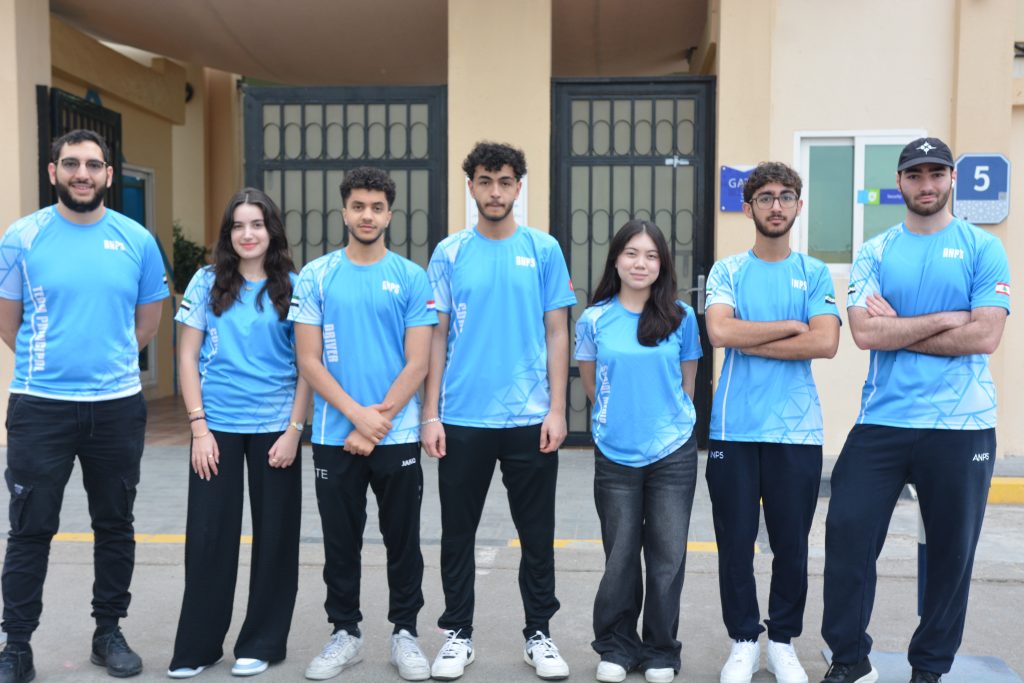
High School life at ANPS extends well beyond lessons and examinations. Students are given structured opportunities to contribute, work alongside adults, serve their community, lead important events and learn what responsibility looks like in practice.
These experiences are not presented as decorative additions to academic life. They help students develop reliability, communication, initiative, teamwork, ethical judgement and the confidence to operate in real environments—qualities that universities and future employers value.
Career and University Guidance
Guiding Every Student Towards the Right Future
Career and university guidance begins before students reach their final year. Students are supported as they explore strengths, interests, subject choices, university options and career pathways so that important decisions are made with evidence and purpose.
- IGCSE subject-choice guidance
- Year 11 to Year 12 pathway guidance
- IAL and IB programme advice
- University application support
- Career exploration and individual planning
- University fairs, visits and guest speakers
- Individual student and parent meetings
- Destination-specific guidance for the UAE and international universities
- Support with Ministry of Education equivalency requirements
Students are encouraged to communicate regularly with subject teachers, the Career Counsellor and the High School Office when making academic decisions.
The ANPS Student Internship Programme
Real Responsibility Inside the School
Through the Student Internship Programme, High School students take on supervised roles within the daily life of ANPS. Students apply for placements, receive guidance from staff supervisors, complete agreed responsibilities and record verified credit hours.
The programme allows students to explore possible career interests while learning how professional environments operate. It also helps them build a credible record of experience that can support university applications, personal statements and future interviews.
Examples of Internal Placements
Science Laboratories
Supporting preparation and organisation of practical materials, laboratory safety routines, inventory and science-event displays under staff supervision.
School Library
Assisting with book organisation, displays, reading initiatives, research support and library events.
School Clinic
Learning about healthcare environments through appropriate administrative and awareness tasks under the supervision of the school nurses.
Sports Facilities
Supporting equipment organisation, event logistics, fixtures, sports-day preparation and safe use of facilities.
School Magazine and Media
Writing, interviewing, editing, photography, design and documenting school life through the student magazine and related media projects.
Events and Hospitality
Supporting registration, visitor guidance, stage preparation, logistics and communication during school events.
Technology and Digital Support
Helping with approved classroom technology, presentations, coding activities, robotics events and digital-content preparation under supervision.
Peer Academic Support
Supporting younger students through reading, revision, study-skills or subject-based mentoring programmes where appropriate.
Volunteering and Community Action
Learning to Contribute, Not Simply Participate
ANPS encourages students to understand that community service is most valuable when it responds to a real need and is carried out with consistency and respect. Volunteering opportunities take place both within school and in the wider Abu Dhabi community, with activities selected according to student age, safety, availability and partner requirements.
Examples of Environmental and Community Service
- Waste-segregation, recycling and responsible-consumption campaigns within the school
- Waste-management awareness projects and student-led audits of paper, plastic and food waste
- Mangrove awareness, habitat-preservation and restoration-related activities in Abu Dhabi
- Beach, waterfront, park and neighbourhood clean-up campaigns
- Biodiversity awareness, eco-ranger and environmental-monitoring activities where available
- Tree planting, school greening and water-conservation initiatives
- Food packing, donation drives and community distribution campaigns
- Reading, mentoring and educational support activities for younger learners
- Support for People of Determination through inclusive events and community initiatives
- Animal-welfare awareness and approved support drives
- Volunteering at cultural, sporting and community events across Abu Dhabi
- Health, wellbeing and public-awareness campaigns led in partnership with relevant organisations
Where applicable, students document their service, reflect on its impact and record verified volunteering hours. The emphasis is on genuine contribution, responsible conduct and learning from the communities and environments they serve.
Students at the Centre of School Events
Planning, Hosting and Delivering
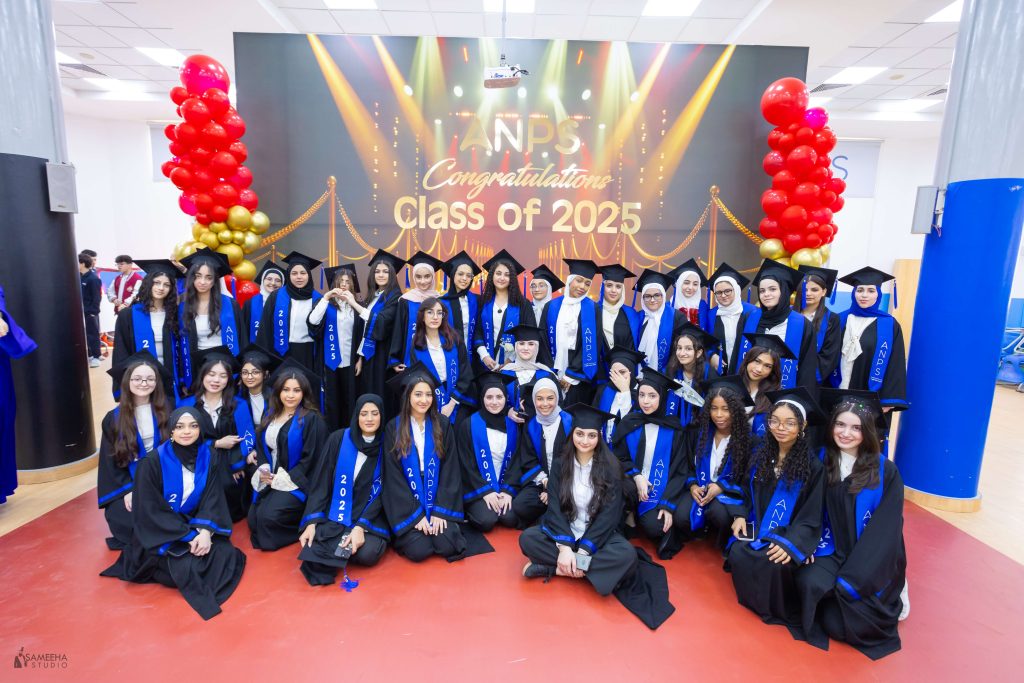
At ANPS, students do not simply attend major events; they help create them. Information evenings, open days, graduation, university events, award ceremonies, national celebrations and whole-school activities provide authentic opportunities for students to work as planners and executors on the ground.
Depending on the event, students may contribute through:
- Planning schedules, spaces and visitor journeys
- Welcoming families and managing registration
- Leading school tours and answering questions from a student perspective
- Serving on student panels during information evenings and open days
- Preparing academic displays, demonstrations and programme presentations
- Writing scripts, presenting, hosting and acting as masters of ceremony
- Supporting stage management, audio-visual systems and presentation logistics
- Coordinating seating, ushering and backstage movement during graduation
- Creating photography, video, interviews and written coverage for school media
- Gathering feedback and evaluating how future events can be improved
This level of involvement gives students a genuine sense of ownership. They learn to work under pressure, communicate with different audiences, solve problems quickly and represent their school with maturity.
Leadership in Action
Student leadership at ANPS is not limited to titles. It is demonstrated through reliable action: leading initiatives, mentoring younger students, representing student voice, organising events, contributing to clubs and taking responsibility when others depend on them.
Through student councils, committees, clubs, assemblies, competitions, mentoring and service projects, students learn how to listen, plan, negotiate, communicate and follow through. The result is a school culture in which students are visible contributors rather than passive participants.
Beyond the Classroom
Competitions, clubs, projects, sports, arts, publications, university sessions and community initiatives allow students to test their abilities in different settings. These opportunities help students recognise interests, build a stronger personal profile and develop the confidence to take the next step beyond school.
University Readiness
Prepared for the Next Step
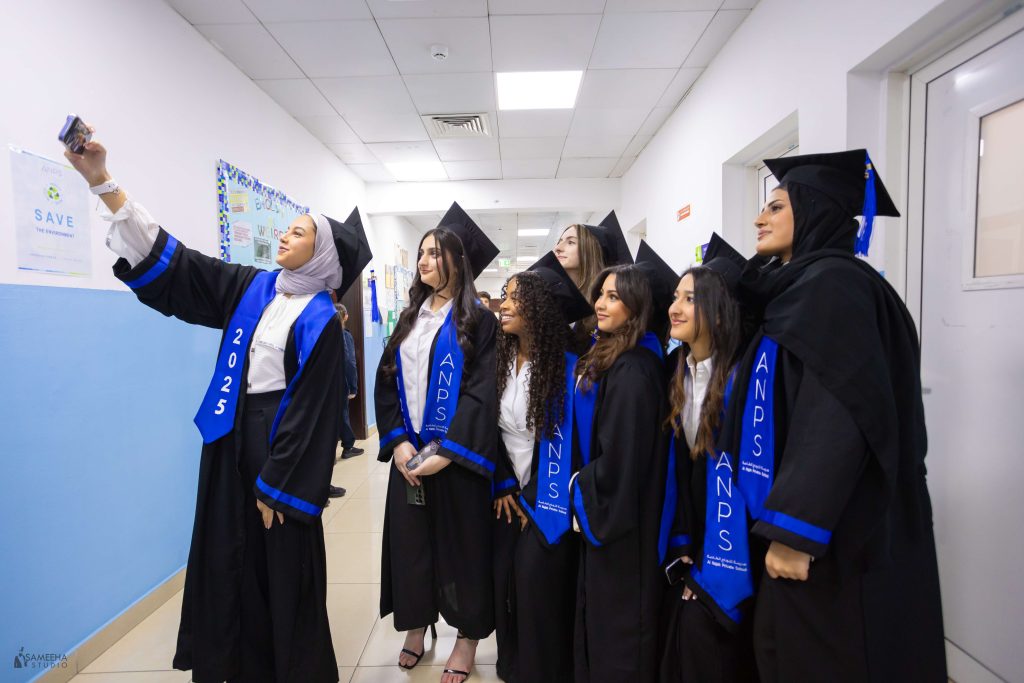
By graduation, ANPS students are expected to have developed academic skills, personal confidence and a realistic understanding of their future options. They are guided to interpret university requirements, select suitable subjects, prepare applications and communicate their experiences with clarity.
Academic qualifications remain central, but internships, volunteering, event leadership and sustained involvement help students explain who they are, what they have contributed and how they are prepared to engage with university life.
IB Subject Offerings
- Group 1: English A: Literature, Arabic A: Language and Literature
- Group 2: French ab initio
- Group 3: Business Management
- Group 4: Biology, Physics, Chemistry, Computer Science
- Group 5: Mathematics: Analysis and Approaches
Offered through external collaboration: Psychology, Philosophy, Economics, Dutch A, Film Studies, Spanish ab initio.

Head of High School
Mr. Ahmad Rai
Join Us
Discover the people, pathways and experiences that shape life at ANPS
The best way to understand Middle and High School life at ANPS is to meet our students, speak with our teachers and see learning in action. Families are welcome to contact the school to learn more about KS3, IGCSE, International A Levels, the IB Diploma Programme, career guidance and student life.